

The cycle moves quickly in international football. One moment a nation is rebuilding, questioning its direction and wondering where the next generation will come from. The next, it suddenly feels ahead of everyone else again.
Spain know this pattern better than most.
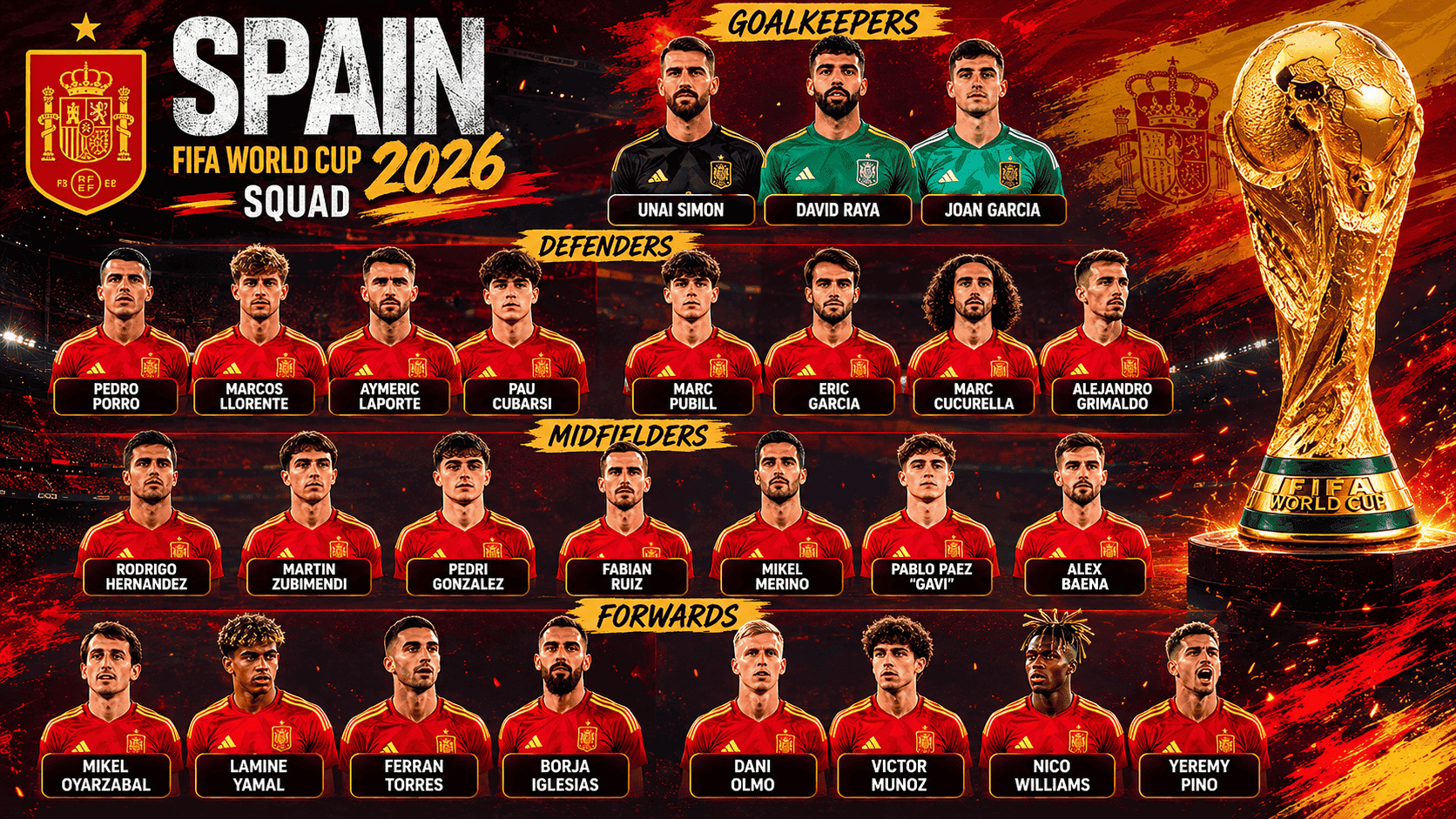
The Spain World Cup Squad 2026 arrives carrying a very different feeling compared to previous tournaments. The uncertainty that followed the post-golden generation years has largely disappeared. What replaced it is a squad built around technical quality, positional intelligence and young players who already look comfortable on the biggest stages.
This is no longer a side searching for identity.
They know exactly what they are.
Under a new generation of talent, Spain have moved away from possession for possession’s sake. The old stereotype of endless sideways passing has gradually faded. There is still control, naturally, but there is more speed now. More directness. More willingness to attack space when opportunities appear.
And perhaps most importantly, Spain suddenly look balanced.
Goalkeepers
For years, Spain rotated goalkeepers while searching for certainty after the era of legends.
That search feels over.
Unai Simón remains the clear first choice and brings something modern international football increasingly demands — calmness under pressure. Spain build attacks from deep and expect their goalkeeper to participate rather than simply clear danger.
Simón fits naturally into that system.
David Raya offers a different profile and remains one of Europe’s stronger distributors from deeper areas, while Joan García enters as one of the more interesting younger names in the group.
Goalkeepers rarely dominate World Cups.
Until they do.
And tournament football often changes because of one save.
| Player | Club |
|---|---|
| Unai Simon | Athletic Club |
| David Raya | Arsenal |
| Joan Garcia | Barcelona |
Defenders
Spain’s defensive structure feels very different from previous generations.
There is less emphasis on experience and far more belief in youth.
Pau Cubarsí already plays with composure that should not make sense for his age. Watch his body positioning and decision-making closely. He rarely appears rushed.
Alongside him, Aymeric Laporte provides authority and leadership, while Eric García offers versatility across multiple roles.
The wider areas may define Spain tactically.
Marc Cucurella and Alejandro Grimaldo push high and naturally create width, while Pedro Porro and Marcos Llorente bring intensity and athleticism down the right side.
The strength is obvious.
So is the risk.
Aggressive full-backs can leave space behind them, especially against teams built around transitions.
| Player | Club |
|---|---|
| Pau Cubarsi | Barcelona |
| Marc Cucurella | Chelsea |
| Eric Garcia | Barcelona |
| Marcos Llorente | Atletico Madrid |
| Alejandro Grimaldo | Bayer Leverkusen |
| Pedro Porro | Tottenham |
| Marc Pubill | Atletico Madrid |
| Aymeric Laporte | Athletic Bilbao |
Midfielders
This remains Spain’s heartbeat.
Always has been.
Rodri arrives as arguably the most important player in the squad because he controls almost everything. Tempo, positioning, defensive protection — much of Spain’s structure begins with him.
Pedri and Gavi bring familiarity together, but they offer different qualities. Pedri slows matches down and manipulates spaces with intelligence. Gavi creates chaos through energy and pressing.
Then there is Fabián Ruiz, Mikel Merino and Martín Zubimendi providing control and balance.
Alex Baena adds another layer through creativity and movement between the lines.
Spain’s midfield depth matters because tournament football eventually becomes tactical warfare. Possession alone does not win knockout matches.
Control does.
| Player | Club |
|---|---|
| Pedri Gonzalez | Barcelona |
| Fabian Ruiz | PSG |
| Martin Zubimendi | Arsenal |
| Gavi | Barcelona |
| Rodri | Manchester City |
| Alex Baena | Atletico Madrid |
| Mikel Merino | Arsenal |
Forwards
This is where the new Spain feels different.
For years, Spain produced midfielders endlessly but often lacked game-changing forwards.
Not anymore.
Lamine Yamal – Barcelona
Lamine Yamal enters the tournament carrying expectations most players spend entire careers trying to reach.
Yet he rarely plays like someone feeling pressure.
He receives possession aggressively, attacks defenders immediately and makes decisions that look years beyond his age.
Spain already trust him.
That says enough.
Nico Williams – Athletic Club
Nico Williams gives Spain something international football desperately values: speed that changes defensive structures instantly.
Opponents cannot defend him passively. They have to react.
And once defensive lines begin shifting toward him, space opens elsewhere.
The Next Wave
Ferran Torres, Yeremy Pino and Dani Olmo bring flexibility across multiple attacking positions, while Mikel Oyarzabal and Borja Iglesias provide different options depending on opposition.
Victor Muñoz also enters as one of the younger names capable of making noise if opportunities appear.
Different profiles.
Different solutions.
| Player | Club |
|---|---|
| Lamine Yamal | Barcelona |
| Nico Williams | Athletic Bilbao |
| Victor Munoz | Osasuna |
| Ferran Torres | Barcelona |
| Yeremy Pino | Crystal Palace |
| Borja Iglesias | Celta Vigo |
| Dani Olmo | Barcelona |
| Mikel Oyarzabal | Real Sociedad |
Read More: Spain FIFA World Cup 2026 Match Schedule
Key Players to Watch
Lamine Yamal will naturally attract headlines.
But Rodri may still be Spain’s most important footballer.
Keep an eye on Gavi too. Tournament football rewards intensity and emotional energy, and few players bring more of it.
Tactical Analysis: How Spain Could Play
Spain will likely operate within a flexible 4-3-3 built around midfield rotations and positional movement.
Possession remains central.
But there is more verticality now.
The biggest question is whether Spain’s aggressive structure can survive against elite counter-attacking sides.
Because World Cups rarely expose weaknesses slowly.
They expose them all at once.

