

Every World Cup cycle, France arrive carrying the same burden: expectation. Not hope. Not optimism. Expectation.
That is the reality when your talent pool runs this deep. The France FIFA World Cup 2026 Squad announcement never felt like a routine selection process; it felt like another reminder of the country’s endless production line of talent. For every player named, there is another sitting at home who would strengthen most national teams.
This time, though, there is another storyline hanging over Les Bleus.
This is Didier Deschamps’ final tournament in charge.
After more than a decade on the France bench, one World Cup title and another final appearance, Deschamps enters his last campaign with a squad that feels like both a farewell and a calculated risk. He has not selected players based on reputation alone. He has picked profiles that fit how he wants France to play.
No Antoine Griezmann. No Eduardo Camavinga. No Randal Kolo Muani. No Hugo Ekitike.
Those omissions tell their own story. Camavinga’s absence in particular reflects where France are right now. Injuries interrupted his rhythm, competition intensified and Deschamps moved on. This squad feels younger, quicker and more direct than previous versions.
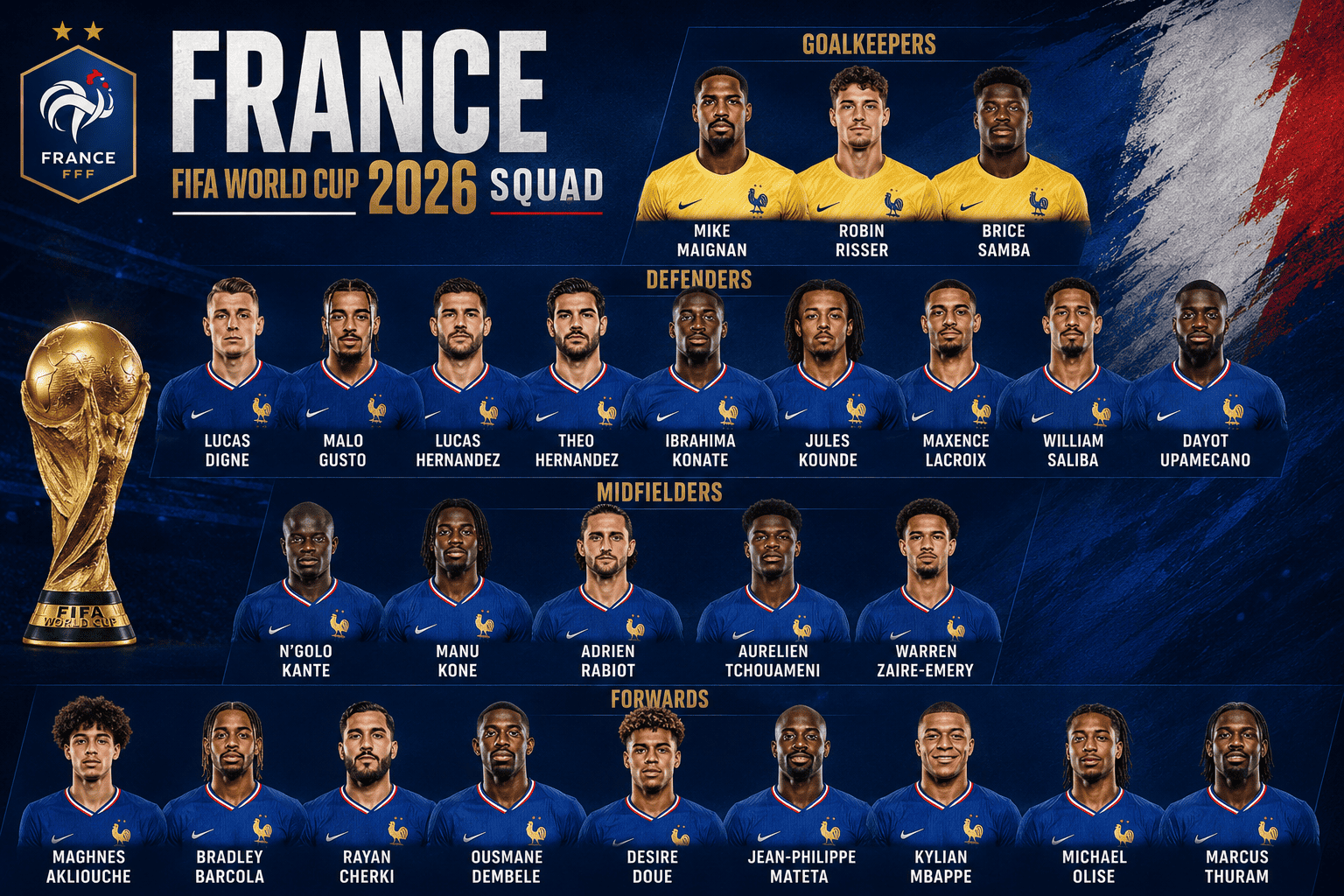
France FIFA World Cup 2026 Squad
Goalkeepers
France have very little uncertainty here.
Mike Maignan has developed into one of Europe’s most complete goalkeepers. Modern international football demands more than shot-stopping and Maignan gives France everything: command of his area, distribution and leadership.
Brice Samba remains dependable backup, while Robin Risser arrives as one of the more intriguing names in the squad.
Every World Cup introduces a surprise story. France may already have theirs.
| Player | Club |
|---|---|
| Mike Maignan | AC Milan |
| Robin Risser | Lens |
| Brice Samba | Rennes |
Defenders
Tournament football is often decided by defensive partnerships.
William Saliba has become exactly the type of centre-back coaches trust in knockout football. Calm under pressure and comfortable in possession, he rarely looks rushed.
Alongside him, Dayot Upamecano and Ibrahima Konaté provide physicality and recovery speed. Then there is Jules Koundé, whose versatility gives Deschamps flexibility across multiple systems.
France also have a luxury few teams possess: both Hernández brothers available.
Theo Hernández stretches games with attacking runs and width. Lucas Hernández offers control and defensive balance.
Malo Gusto and Maxence Lacroix add important depth over a long tournament.
| Player | Club |
|---|---|
| Ibrahima Konate | Liverpool |
| Jules Kounde | Barcelona |
| Theo Hernandez | Al-Hilal |
| Lucas Hernandez | PSG |
| Lucas Digne | Aston Villa |
| Malo Gusto | Chelsea |
| Dayot Upamecano | Bayern Munich |
| William Saliba | Arsenal |
| Maxence Lacroix | Crystal Palace |
Midfielders
This area could decide France’s World Cup.
Not because of quality.
Because of workload.
N’Golo Kanté remains one of football’s most fascinating players. At 35, his physical profile may have changed, but his ability to read danger remains elite.
The concern is simple: can France maintain his level over seven matches?
Aurélien Tchouaméni carries major responsibility as midfield anchor, while Adrien Rabiot still offers physicality and Manu Koné brings energy.
Then there is Warren Zaïre-Emery.
He simply does not play like a teenager and could become one of France’s most important players.
France also possess more creative midfield solutions than previous squads. Michael Olise and Rayan Cherki can both drift into central attacking areas rather than stay fixed out wide. Olise offers control, vision and delivery, while Cherki brings unpredictability and the ability to break compact defensive structures.
That flexibility could become one of Deschamps’ biggest tactical advantages.
| Player | Club |
|---|---|
| Michael Olise | Bayern Munich |
| Aurelien Tchouameni | Real Madrid |
| Adrien Rabiot | AC Milan |
| Warren Zaire-Emery | PSG |
| Manu Kone | Roma |
| Rayan Cherki | Manchester City |
| N’Golo Kante | Fenerbahce |
Forwards
This is where France separate themselves.
Kylian Mbappé
Kylian Mbappé enters his third World Cup with 56 international goals and sits one goal away from Olivier Giroud’s France record.
Still young. Already experienced.
France become a different side when he plays.
Ousmane Dembélé
For years, discussions around Dembélé focused on inconsistency. Those conversations have largely disappeared.
Mbappé attacks space. Dembélé creates from tighter situations.
Different qualities. Same objective.
The Next Wave
Bradley Barcola and Désiré Doué bring creativity and unpredictability, while Marcus Thuram, Jean-Philippe Mateta and Maghnes Akliouche complete an attack with real depth.
| Player | Club |
|---|---|
| Kylian Mbappe | Real Madrid |
| Desire Doue | PSG |
| Ousmane Dembele | PSG |
| Marcus Thuram | Inter Milan |
| Jean-Phillipe Mateta | Crystal Palace |
| Bradley Barcola | PSG |
| Maghnes Akliouche | Monaco |
Key Players to Watch
Mbappé will dominate attention, but France’s success may depend elsewhere.
Saliba’s consistency becomes crucial once knockout football arrives, while Kanté sustaining his level across the tournament could be equally important.
Keep an eye on Rayan Cherki too. Every World Cup creates a breakout player, and he feels like a strong candidate.
Tactical Analysis: How France Could Play
Deschamps rarely overcomplicates things.
France will likely operate in a 4-3-3 or 4-2-3-1 depending on the opposition. The idea remains straightforward: recover possession quickly, attack space and let the quality in wide areas create opportunities.
The biggest question remains midfield management.
Because World Cups rarely reward talent alone.
Also Read:
Portugal FIFA World Cup 2026 Squad
Spain World Cup Squad 2026

